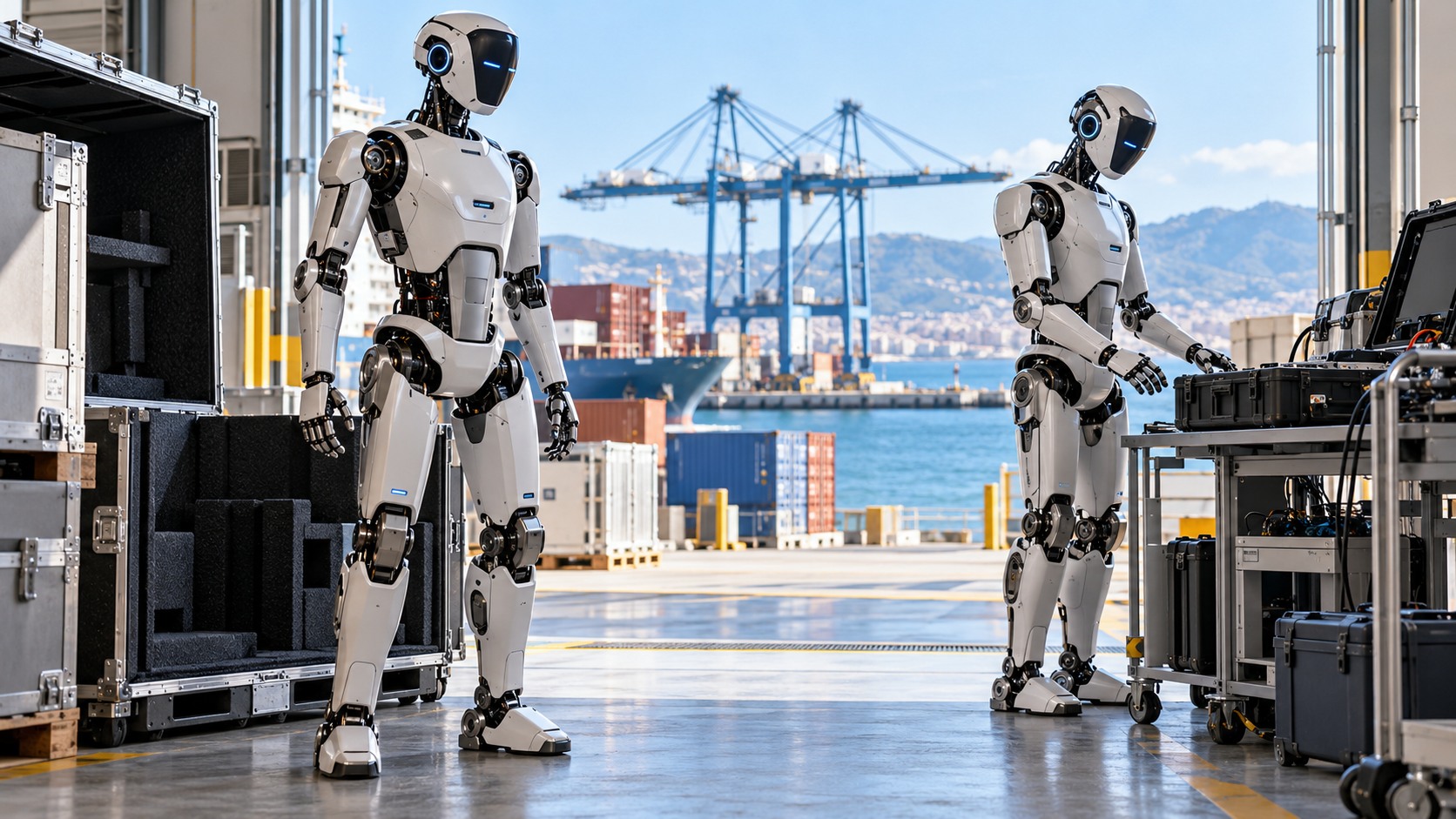
Humanoid robots are moving into commercial applications, and manufacturers are building the distribution, technical support and development capabilities needed to reach customers abroad. For producers based in China and other international technology centres, the next business question is how to establish a practical presence in Europe.
Italy deserves consideration as a base for importing robots, managing European sales, keeping spare parts, employing technicians and, where the project supports it, assembling products or developing software locally. Its Mediterranean position and connections with European transport corridors can bring the supply chain and the customer-facing operation together.
This guide explains how an Italian robotics company can be organised, how import VAT and European sales interact, and which innovation incentives may fit a genuine development or production project. ISY's company formation and market-entry service can coordinate the initial structure and the accounting, tax, legal and employment work that follows.
A growing market creates a need for local operations
Counterpoint Research reported more than 22,000 humanoid robot shipments worldwide in the first half of 2026, up nearly 300% year on year. Its ranking was led by AGIBOT and Unitree, followed by Galbot, UBTECH and Leju Robotics. These are shipment estimates for the research firm's defined market, rather than a count of every robot in use.
That expansion creates commercial opportunities beyond the original manufacture of the hardware. A supplier may need a distributor, a demonstration site, an integration team or a partner that can service units close to the customer. For the business plan, identify the intended applications, customer segment and service commitments: a university research platform, a factory application and a customer-facing service robot can require different operating arrangements.
Why Italy can work as a gateway for European distribution
Italy's position in the Mediterranean is relevant to companies importing from Asian manufacturing centres and planning an EU distribution network. Invest in Italy's logistics overview highlights the country's ports, freight terminals, road and rail infrastructure and role in European transport networks.
The connections are concrete. The European Commission's Mediterranean Corridor description includes Genoa, La Spezia and a northern Italian network connecting with France and Central and Eastern Europe. The Baltic Sea–Adriatic Sea Corridor connects Italian ports, including Trieste and Venice, with Central European routes.
For a robotics supplier, a possible operating model is to receive units through an Italian port, prepare and store them locally, and supply customers through a combination of direct sales and distributors. The same base can hold spare parts, support demonstrations and coordinate repairs. Locating technical capability near stock can be commercially valuable when customers need installation, training or continuing assistance.
Once goods have been properly released for free circulation, they acquire Union customs status and can generally move within the EU customs territory without a new import clearance at every Member State border. VAT treatment and product obligations still follow the actual transactions. Sales to European countries outside that territory, such as Switzerland or the United Kingdom, require separate customs planning.
The appropriate port and warehouse depend on shipping services, final destinations, handling needs, inland transport and total operating cost. Italy's location is a useful reason to evaluate it; the financial comparison should use the project's actual routes and service requirements.
Choose what the Italian company will actually do
Define the local activities before choosing the structure or applying for incentives. The same group can begin with distribution and add technical or development functions as demand grows.
| Operating model | Activities in Italy | Planning priorities |
|---|---|---|
| Import and distribution | Purchase robots, hold stock, sell to Italian and EU customers, manage demonstrations and spare parts. | Importer identity, customs, VAT, stock ownership, customer contracts and working capital. |
| Assembly and technical support | Assemble components, configure units, integrate equipment, provide installation, training and maintenance. | Premises, technicians, safety and product responsibilities, insurance and service terms. |
| Development and production | Develop software, control systems, components or new applications; carry out eligible research and manufacturing. | Personnel, intellectual property, project records, innovation eligibility and investment funding. |
An Italian S.r.l. can provide a distinct local contracting and employing entity. A branch, an independent distributor or another existing EU structure may also fit particular projects. The assessment should compare responsibilities, local resources and recurring obligations. Our branch versus subsidiary guide explains the main structural differences.
Planning an Italian sales or technology operation? ISY can help define the corporate, VAT and employment structure before incorporation through a coordinated market-entry assessment.
Set up the company and the operating foundations together
For a foreign-owned S.r.l., the preparation normally starts with the shareholder documents, ownership structure, authorised signatories, proposed directors, registered office, business activities and capital arrangements. Foreign corporate documents may require authentication and translation. Banking requirements and the evidence needed from the parent company should be considered early.
The activity description should reflect the intended business: distribution, equipment rental, maintenance, software development and manufacturing should be assessed according to what will actually be carried out. Company formation is followed by the relevant tax, accounting, invoicing and operating registrations.
The budget should cover both incorporation and ongoing management. Include premises or logistics services, staff, insurance, accounting, payroll, technology support and the funding needed for stock and customer payment terms. ISY can coordinate the formation process and maintain the resulting operation through its accounting services and Italian tax compliance support.
Plan customs, import VAT and EU sales before the first shipment
For the initial import, identify which entity buys the robots, which entity is named in the customs declaration and who is responsible for the commercial and product obligations. The European Commission explains that an EORI number is required for customs operations. A customs broker can assess classification, origin, customs value and the duties applicable to the actual product.
Import VAT also needs a funding and documentation plan. Under the EU's cross-border VAT guidance, VAT is generally payable on business imports and may subsequently be deductible where the conditions are satisfied. Recoverable import VAT can therefore still create a cash-flow requirement. Confirm entitlement and the import accounting evidence before building recovery into the financial forecast.
After import, distinguish domestic supplies from goods dispatched to VAT-registered businesses in other Member States. The latter may qualify for intra-Community treatment when the applicable conditions are met. Customer VAT status, actual movement of goods, transport evidence and reporting must align. Installation contracts, consumer sales, rental and stock in additional countries require their own assessment.
Map hardware, software subscriptions and support services in the contracts and accounting system. Their VAT treatment depends on the actual arrangement, including whether supplies form a single transaction. ISY can connect the import workflow with Italian VAT registration and compliance and intra-EU VAT, VIES and reporting support. See also our guide to importer identity and import VAT recovery in Italy.
When can a robotics company qualify as an innovative startup?
A company working with humanoid robots should assess the Italian innovative-startup regime where its own project involves qualifying technological activity. Selling sophisticated equipment alone does not establish eligibility.
The Chamber of Commerce's current requirements include company age, the European SME definition, production-value limits, restrictions on profit distributions and the nature of the business. The company must also meet at least one statutory innovation criterion concerning R&D expenditure, qualified personnel or qualifying intellectual property. The rules exclude predominantly agency or consultancy activities.
Foreign groups should check size at group level. The MIMIT circular of 30 July 2025 requires consideration of linked and partner enterprises and states that startups associated with, linked to or controlled by large enterprises are not eligible. A small Italian subsidiary cannot establish SME status merely by looking at its own initial turnover and employees.
For a suitable project, registration and ongoing confirmation of the status should be planned alongside incorporation. ISY can assess the proposed activities and ownership structure, with further background in our guides to setting up an innovative startup and the associated benefits and conditions.
Which incentives could support a robotics project?
The opportunity depends on who makes the investment, what is being developed or purchased, where the activity takes place and the applicable eligibility rules. An interest-free loan, an enhanced tax deduction and a tax credit affect the business plan differently.
Smart&Start Italia: financing an eligible technology startup
Invitalia's Smart&Start Italia supports qualifying innovative startups through interest-free financing covering 80% of eligible costs, rising to 90% where the specific ownership or researcher conditions are met. It is a financing instrument; those percentages are not a general cash grant.
The programme covers business plans from EUR 100,000 to EUR 1.5 million, including eligible equipment, services, personnel and operating costs. A robotics software, component or application-development project may be a relevant candidate. Foreign applicants must meet the programme's conditions and establish the required Italian presence. Confirm admission, cost timing and available resources before committing expenditure.
Research and development tax credit
The MIMIT R&D tax-credit guidance provides for a 10% credit for qualifying research and development through the tax period current on 31 December 2031, with an annual ceiling of EUR 5 million. Eligibility depends on the activities and costs, rather than on having “robotics” or “AI” in the company description.
A project developing an original capability or resolving a technological uncertainty should be examined against the statutory research criteria. Routine configuration, ordinary engineering and standard customer adaptations should be assessed separately. Define the research work, personnel records, cost evidence and required technical and accounting documentation from the start. Innovative-startup status and R&D-credit eligibility are separate assessments.
Patent Box for qualifying software and intellectual property
The Italian Revenue Agency's Patent Box guidance describes a 110% uplift on qualifying R&D costs connected with eligible intellectual property, including copyright-protected software, patents and legally protected designs. This is an enhanced deduction in calculating the relevant taxable bases, rather than a 110% reimbursement.
For a robotics business, the assessment should identify the eligible asset, rights held, development activities, economic use and costs borne by the claimant. Software and intellectual property retained by an overseas parent require particular attention to the Italian company's actual rights and functions. The current legislative provision and the rules applicable to the claim period should be checked when preparing the engagement.
Nuova Sabatini and project-specific investment support
Nuova Sabatini was refinanced for 2026 and 2027 to support qualifying SME productive investment through contributions linked to bank or leasing finance. It can be relevant to equipment used in an Italian assembly, testing or manufacturing operation.
The official eligible-cost rules concern new productive assets and qualifying software. Robots purchased as inventory for resale are different from equipment used by the business itself. Other regional or project-specific opportunities should be checked against current calls, location, company size and expenditure rules.
Build one funding schedule for the project, identifying eligible costs, application dates, payments, supporting evidence and any limits on combining measures. ISY can coordinate the fiscal and accounting assessment with the technical project and any specialist funding work.
Assembly, software and product responsibilities need a common plan
An Italian operation can grow from sales into testing, configuration, assembly or software development. Record which entity owns the components, work in progress and finished products, who holds the software rights and who contracts with customers. Where group companies trade goods, services or licences, the agreements and accounting should reflect their actual functions. Our guide to transfer pricing and intercompany agreements explains the planning issues.
The European Commission's importer and distributor guidance sets out responsibilities for checking product conformity. An operation placing a product on the market under its own name or modifying it needs an assessment of its resulting role. The applicable rules depend on the robot's features, intended use and modifications.
For robots falling within machinery legislation, the Commission confirms that the Machinery Regulation (EU) 2023/1230 becomes mandatory on 20 January 2027; the current Machinery Directive applies before that transition. Product specialists should identify the relevant machinery, electrical, radio, software and other requirements for the particular model. ISY can coordinate the corporate and contractual work with those specialists.
Organise the local team and the customer offer
A sales manager, integration engineer and service technician perform different functions. Define the employing entity, duties, applicable employment terms, salary budget, workplace arrangements and travel requirements before hiring. ISY's HR and labour consulting and managed payroll services can support the local team and reporting to foreign headquarters.
Customer and distribution agreements should identify the product supplied, acceptance tests, installation scope, software access, updates, training, warranty and maintenance arrangements. Responsibility for spare parts, downtime and repairs should be clear. ISY's legal support can coordinate these terms with the business model, the parent-company arrangements and the relevant technical advice.
Example: from an overseas manufacturer to an Italian EU sales base
Consider a foreign manufacturer planning to sell humanoid robots to Italian, French and German business customers. It wants stock and demonstrations in Italy, two service technicians and a local commercial contact.
An Italian subsidiary could purchase units from the manufacturer, act as the planned importer, hold stock and spare parts, sign customer contracts and employ the local team. Its logistics provider and customs broker would manage the agreed physical and customs operations, while its professional advisers coordinate VAT, accounting, payroll and contracts.
If the same business later adds an Italian team developing original robot-control software, that activity creates a separate question about qualifying R&D, intellectual property and incentives. The development project needs its own evidence and eligibility analysis. A distribution operation can have a sound commercial rationale even where innovative-startup status is unavailable.
How ISY can support your robotics business in Italy
ISY provides a coordinated Italian point of contact for foreign companies and investors. The engagement can cover the route from structure selection and formation to the recurring financial, tax, employment and legal work of the Italian operation, with communication in English for headquarters.
- Company formation and market entry: assess the local activities, compare structures and coordinate the incorporation and operating setup.
- VAT registration and management: connect imports, stock, sales, invoicing and recurring VAT obligations.
- Intra-EU VAT compliance: support customer checks, transaction evidence and the applicable reporting workflow.
- Accounting and tax compliance: maintain records, financial statements, tax returns and reporting to the parent company.
- Payroll and employment support: organise the local workforce and recurring employer obligations.
- Legal and contractual support: coordinate corporate, distribution, service and intercompany agreements.
- Innovation and incentives: assess the ownership structure, relevant activities and costs, and coordinate eligibility, documentation and any specialist technical or funding input.
Planning to sell, assemble or develop humanoid robots in Italy?
Tell us where your company is based, its ownership structure, the robots and applications involved, expected import and sales flows, proposed staff and investment budget. ISY can define the Italian setup and ongoing support your project requires.
Frequently asked questions
Why consider Italy for a humanoid robot distribution business?
Italy combines Mediterranean ports with rail and road connections to European markets. An Italian base can bring imports, stock, demonstrations, spare parts and customer support together. Compare the actual shipping routes, customer locations and total operating cost before selecting the site.
Can robots imported into Italy be sold to other EU countries?
After proper release for free circulation, goods generally have Union customs status and can move within the EU customs territory. VAT treatment, transport evidence, reporting and product requirements still depend on the transactions. European countries outside that territory require separate customs planning.
Does selling humanoid robots automatically qualify a company as an innovative startup?
No. The company must meet the statutory corporate, size, activity and innovation conditions. Commercialising sophisticated products alone is insufficient. The ownership structure and linked or partner enterprises also matter, particularly for subsidiaries of large foreign groups.
Can a foreign-owned Italian company apply for innovation incentives?
Foreign ownership does not replace the eligibility assessment. Each measure has its own requirements concerning the applicant, group size, Italian presence, project and costs. Qualifying foreign projects can be considered under programmes such as Smart&Start, subject to their specific conditions.
Are Smart&Start and the R&D tax credit the same benefit?
No. Smart&Start provides interest-free financing for eligible plans. The R&D tax credit concerns qualifying research activities and costs. Patent Box is a further, distinct enhanced deduction for eligible intellectual property-related costs. Each measure must be assessed separately, including any combination rules.
Can Nuova Sabatini finance robots bought for resale?
The measure concerns qualifying productive assets used by the business and eligible software. Robots held as trading inventory for resale are different. Assess equipment used in the company’s own assembly, testing or production operation under the official cost and applicant rules.
Does setting up the company cover CE marking and robot safety?
Company formation and technical product conformity are separate workstreams. The applicable requirements depend on the robot, intended use and role of each operator. ISY can coordinate corporate, tax and contractual work with the product specialists responsible for the technical assessment.
What does ISY need to assess an Italian robotics project?
Start with the home country, ownership structure, products and intended applications, proposed Italian activities, expected import and sales flows, staff and investment budget. Identify any software development or manufacturing work separately so the setup and potential incentive scope can be defined.
Sources and scope
Information and source references checked on 30 October 2026. The operating models and example are illustrative planning options. Incentive eligibility depends on the applicant, group relationships, project, costs, location and rules applicable to the claim period. Market figures are attributed to Counterpoint Research and are distinct from official tax and regulatory guidance.
- Counterpoint Research — humanoid robot shipments in the first half of 2026
- Invest in Italy — logistics and infrastructure
- European Commission — Mediterranean transport corridor
- European Commission — Baltic Sea–Adriatic Sea transport corridor
- European Commission — importation and release for free circulation
- European Commission — EORI registration
- Your Europe — cross-border VAT, including imports and EU sales
- Chamber of Commerce of Milan Monza Brianza Lodi — innovative-startup requirements
- MIMIT — circular of 30 July 2025 on innovative startups and group-size requirements
- Invitalia — Smart&Start Italia
- Invitalia — eligible Smart&Start business plans and costs
- MIMIT — research and development tax-credit rules
- Italian Revenue Agency, official MEF archive — Circular 5/E of 24 February 2023 on Patent Box
- Official MEF legislation archive — current Patent Box provision
- MIMIT — Nuova Sabatini refinancing for 2026–2027
- MIMIT — Nuova Sabatini eligible costs and programme FAQ
- European Commission — importer and distributor product responsibilities
- European Commission — machinery legislation and the January 2027 transition